AI in contact center is reshaping how companies handle every interaction, from a quick billing question to a complex technical issue. With innovations like Voice Bot AI - 음성 봇 AI, businesses can automate routine tasks while maintaining a human-like, personalized experience. Understanding why AI is essential for business scalability is key - when implemented thoughtfully, AI does far more than reduce costs. It elevates customer experience, empowers agents, and turns your contact center into a strategic growth engine instead of a cost center.
Modern intelligent cloud platforms for AI allow call centers to store, process, and analyze massive volumes of customer data in real time. These platforms make it easier for AI-driven systems, like predictive routing or automated issue resolution, to work seamlessly across channels. By adopting cloud-based AI, contact centers can scale operations without investing heavily in physical infrastructure, providing both flexibility and cost efficiency.
The backbone of AI-driven call centers is next-generation computing solutions. High-performance computing and advanced algorithms enable real-time speech recognition, sentiment analysis, and predictive analytics. With these technologies, agents are equipped with instant insights, allowing them to resolve queries faster and personalize interactions, ultimately improving customer satisfaction and operational efficiency.
In a competitive market, AI-powered customer marketing engagement tools are transforming how businesses communicate with clients. By analyzing customer behaviors and preferences, AI can craft targeted messaging, recommend products, and optimize campaign timing. For call centers, this means automated follow-ups, proactive support, and more meaningful interactions that strengthen customer loyalty.
AI-driven marketing intelligence allows call centers to optimize campaigns based on real-time data and predictive models. From segmenting audiences to testing messaging, these systems help marketing teams make informed decisions quickly. Integrating AI into marketing campaign management also frees up human teams to focus on strategic planning rather than repetitive tasks.
Finally, call centers are increasingly using AI-enhanced financial insights to improve budgeting, forecast workloads, and identify cost-saving opportunities. By analyzing historical data and predicting trends, AI helps managers allocate resources efficiently, reduce operational waste, and ensure that investments in AI technologies deliver measurable returns.
By leveraging these AI-powered capabilities across cloud systems, computing, customer engagement, marketing, and financial planning, call centers can transform into fully optimized, scalable, and customer-centric operations - turning every interaction into an opportunity for growth.
What Is AI in Call Centers?
AI in call centersrefers to the use of artificial intelligence technologies to assist with or automate parts of customer interactions and back-office processes. It is not just a single tool, but an ecosystem of intelligent capabilities that work together.
Common AI components in a modern contact center include:
- Virtual agents and chatbotsthat handle routine questions via voice or chat.
- Voicebots and advanced IVRthat understand natural language instead of rigid keypad menus.
- Natural Language Processing (NLP)that interprets what customers say or type, in their own words.
- Real-time agent assisttools that surface prompts, responses, and knowledge articles during live calls.
- Speech and text analyticsthat analyze 100% of interactions for trends, quality, and compliance.
- Predictive routing and scoringthat match customers to the best available agent based on skills, history, and intent.
- Process automationthat completes repetitive tasks like data entry or after-call work.
When these capabilities are integrated into your call center platform and workflows, they create a seamless experience for both customers and agents.
Best AI Call Center Software Solutions
When it comes to leveraging artificial intelligence in call centers, choosing the right platform can make all the difference in customer experience, agent productivity, and operational efficiency. Here’s a list of the top AI call center solutions in the market today:
1. Bright Pattern
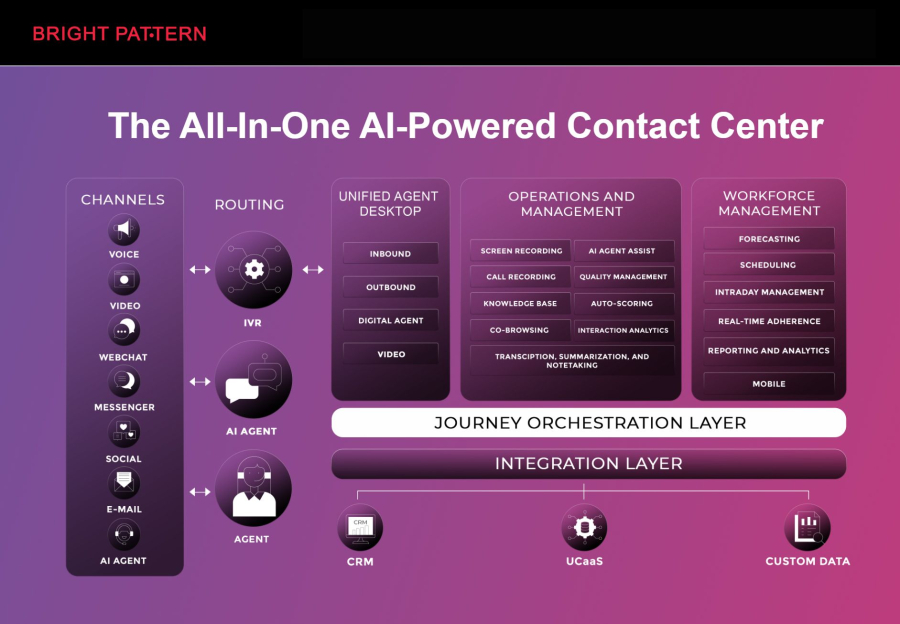
Bright Pattern stands out as a leading AI-powered call center software that combines advanced automation, omnichannel support, and seamless CRM integration. Its AI capabilities include intelligent routing, sentiment analysis, and AI-driven chatbots that help reduce call times and improve customer satisfaction. Bright Pattern also offers robust analytics and reporting tools, allowing businesses to track performance and optimize workflows. The platform’s cloud-based architecture ensures scalability, reliability, and quick deployment, making it an ideal choice for businesses of all sizes looking to transform their customer service operations with AI.
2. Five9
Five9 provides cloud contact center solutions with AI-powered automation and predictive dialing. Its AI features include virtual agents and speech analytics to enhance customer engagement.
3. Genesys
Genesys offers AI-driven call center software that integrates with CRM systems, providing predictive routing, chatbots, and voice analytics to improve customer service efficiency.
4. Talkdesk
Talkdesk delivers an AI-powered cloud contact center platform featuring intelligent routing, AI agents, and workflow automation to enhance both customer and agent experience.
5. NICE inContact
NICE inContact CXone uses AI to optimize workforce management, automate routine tasks, and provide real-time insights for smarter decision-making in call centers.
6. Zendesk
Zendesk’s AI call center features include AI chatbots, automated ticketing, and machine learning analytics that help reduce response times and streamline support processes.
7. Avaya
Avaya’s AI-driven solutions offer conversational AI, predictive engagement, and advanced analytics, enabling more personalized customer interactions.
8. RingCentral Contact Center
RingCentral integrates AI tools such as virtual assistants, sentiment analysis, and real-time transcription to improve call handling and operational efficiency.
9. 8x8 Contact Center
8x8’s AI capabilities include chatbots, speech analytics, and agent assist tools that help optimize customer interactions and reduce call handling times.
10. Amazon Connect
Amazon Connect leverages AWS AI services to deliver intelligent call routing, voicebots, and analytics for improved customer support and operational insights.
Key Benefits of AI-Powered Call Centers
The business case for AI in call centers is increasingly compelling. Organizations that deploy AI thoughtfully tend to see benefits across customer experience, cost, and employee engagement.
1. Faster Response Times and 24 / 7 Availability
Customers expect instant answers, regardless of time zone or channel. AI helps call centers deliver on that expectation.
- Virtual agentscan resolve common questions day and night without waiting in a queue.
- AI-enhanced IVRquickly identifies intent and routes customers to the right self-service flow or specialist.
- Automated callbacksand smart queue management reduce perceived wait times during peaks.
The result is faster response, fewer abandoned calls, and a smoother experience throughout the customer journey.
2. Higher First-Contact Resolution
First-contact resolution (FCR) is one of the clearest indicators of customer satisfaction. AI improves FCR in multiple ways:
- Intelligent routingconnects customers with the right agent or the right self-service flow from the start.
- Real-time guidancegives agents suggested answers, next-best-actions, and relevant policies during the call.
- Unified knowledge basespowered by AI index large volumes of content and surface the exact answer quickly.
This reduces transfers, callbacks, and repeat contacts, which creates a smoother experience and lowers operational load.
3. More Personalized Customer Experiences
Customers want to feel recognized and understood. AI excels at using data to tailor interactions in real time.
- Customer history and contextare surfaced automatically when a call or chat begins, so agents do not have to ask customers to repeat information.
- Next-best-offer or next-best-action modelshelp agents guide customers to relevant products, renewals, or solutions.
- Dynamic scripts and responsesadjust based on sentiment, previous interactions, and customer value.
This level of personalization can increase loyalty, cross-sell and up-sell success, and overall customer lifetime value.
4. Lower Costs and Higher Operational Efficiency
AI allows call centers to handle more interactions with the same or fewer resources, without sacrificing quality.
- Automation of repetitive contacts, such as balance checks or password resets, reduces agent workload.
- Streamlined after-call workwith AI-generated summaries shortens handle times and improves accuracy.
- Smarter staffing and forecastinguse AI models to predict volume and align agent schedules more precisely.
The combined effect is a meaningful reduction in cost per contact and a more scalable operation that can absorb demand spikes without burning out staff.
5. Happier, More Productive Agents
Contrary to some fears, AI can make frontline roles more rewarding by removing low-value tasks and providing real-time support.
- Agent assist toolsreduce the pressure to memorize every policy or product detail.
- Automated logging and note-takingfree agents from tedious documentation.
- AI-driven coaching insightshighlight strengths and targeted improvement areas, making feedback more relevant.
As a result, agents spend more time solving meaningful problems and less time on repetitive chores, which supports higher engagement and lower turnover.
Practical AI Use Cases in Modern Call Centers
AI can touch nearly every part of the call center journey. Here are some of the most impactful and realistic use cases organizations implement today.
1. Intelligent Virtual Agents and Chatbots
Virtual agents handle common and predictable interactions end to end, such as:
- Checking order status or delivery dates.
- Resetting passwords or unlocking accounts.
- Updating contact details or preferences.
- Answering frequently asked questions about billing, fees, or policies.
When the virtual agent reaches its limits, it can hand off to a human agent with full context, so customers do not need to repeat themselves.
2. Natural-Language IVR and Voicebots
Traditional IVR systems force callers through long menus. AI-driven IVR understands what the customer says in plain language and routes accordingly.
For example, instead of pressing numbers, the caller might say, "I want to change my flight," and the system detects the intent, authenticates the caller, and either completes the change automatically or connects them to a specialized agent.
3. Real-Time Agent Assist
Real-time assist tools listen to or read the interaction as it unfolds and provide on-screen guidance. They can:
- Suggest responses and troubleshooting steps.
- Flag compliance language that should be read or confirmed.
- Surface relevant knowledge base articles.
- Detect rising customer frustration so agents can adjust tone and approach.
This support is especially powerful for new hires, shortening ramp-up times and improving consistency across the team.
4. AI-Driven Quality Monitoring and Coaching
Manual call monitoring typically covers only a tiny fraction of interactions. AI-driven analytics can review nearly every call, email, or chat.
- Speech and text analyticsevaluate tone, script adherence, and key phrases.
- Automated QA scoringgives objective, consistent evaluations across all agents.
- Coaching alertsidentify patterns that need attention, such as lengthy dead air or frequent escalations.
This leads to targeted training and a clear link between coaching and performance outcomes.
5. Sentiment and Emotion Analysis
Sentiment analysis uses AI to interpret the emotional tone of interactions. It can detect when a conversation is trending positive, neutral, or negative.
- Supervisors can be alerted to high-risk calls in real time.
- Leaders can identify root causes of dissatisfaction across large volumes of interactions.
- Product and operations teams gain structured feedback on common pain points.
By acting on these insights, organizations can prevent churn, rescue at-risk relationships, and improve products and services.
6. Workforce Management and Forecasting
AI-enhanced forecasting models use historical data, seasonality, marketing activity, and external factors to predict interaction volumes more accurately.
- Scheduling becomes more precise, reducing both overstaffing and understaffing.
- Intraday adjustments are easier when changes in demand are detected early.
Customers benefit from shorter queues, and agents benefit from more balanced workloads.
How AI Supports, Not Replaces, Human Agents
A common misconception is that AI exists to replace agents. In practice, the most successful call centers adopt AI as aco-pilotfor their teams, not a replacement.
AI is especially strong at:
- Handling repetitive, rule-based interactions.
- Searching through large volumes of information instantly.
- Spotting patterns and anomalies across thousands of calls.
Humans are uniquely strong at:
- Building rapport and trust.
- Managing complex, ambiguous situations.
- Exercising judgment and empathy in sensitive moments.
When AI and agents are paired effectively, AI does the heavy lifting in the background while agents focus on high-value tasks that require human insight and emotional intelligence.
Step-by-Step: Implementing AI in Your Call Center
A structured approach helps you capture the benefits of AI while controlling risk and change fatigue. Below is a practical roadmap many organizations follow.
Step 1: Clarify Business Goals and Success Metrics
Before selecting technology, define what success looks like. Examples include:
- Reducing average handle time by a specific target.
- Improving first-contact resolution.
- Raising customer satisfaction or net promoter scores.
- Lowering cost per contact while maintaining quality.
- Shortening new-agent ramp-up time.
Clear goals help you prioritize AI use cases and measure impact.
Step 2: Identify High-Impact, Low-Risk Use Cases
Start small and focus on scenarios where AI can deliver quick wins without disrupting critical workflows.
- Automating routine inquiries that follow clear rules.
- Using AI to summarize calls and generate after-call notes.
- Adding real-time prompts for compliance statements.
These early projects build internal confidence and create momentum for broader transformation.
Step 3: Prepare and Organize Your Data
AI thrives on quality data. Invest time in:
- Consolidating interaction data from phone, email, chat, and messaging channels.
- Cleaning and labeling data where appropriate.
- Clarifying data retention and governance policies.
Good data foundations make AI outputs more accurate, reliable, and useful.
Step 4: Choose the Right Technology Stack
Different vendors offer different capabilities, from all-in-one contact center platforms to specialized AI tools. Consider:
- Ease of integration with your existing telephony, CRM, and ticketing systems.
- Support for your preferred channels and languages.
- Scalability as interaction volumes grow.
- Security, privacy, and compliance features that match your industry.
The best solution is the one that aligns with your goals, processes, and technical environment, not necessarily the one with the most features on paper.
Step 5: Pilot, Learn, and Iterate
Launch AI in a controlled environment first. For example, select one region, product line, or call type as a pilot.
- Set a clear timeline and success criteria.
- Gather feedback from customers, agents, and supervisors.
- Refine workflows, prompts, and escalation paths based on real-world usage.
This iterative approach reduces risk and leads to more sustainable adoption.
Step 6: Train and Engage Your Agents
Agents are central to AI success. Involve them early and often.
- Explain how AI will help them, not replace them.
- Provide hands-on training with new tools and interfaces.
- Invite suggestions on where AI can remove friction from their day-to-day work.
When agents see AI as a partner, they are more likely to embrace it and help you identify additional opportunities.
Step 7: Scale and Optimize
Once pilots prove their value, expand AI to more lines of business and interaction types.
- Continuously monitor performance metrics and user feedback.
- Update AI models and knowledge content as products and policies change.
- Regularly revisit your roadmap to align with new business priorities.
AI in call centers is not a one-time project; it is an ongoing capability that grows more powerful over time.
Measuring the Impact of AI in Your Call Center
To demonstrate value and guide further investment, it is important to measure how AI affects both operational performance and customer experience.
|
Area |
Key Metrics |
Example AI Impact |
|
Customer Experience |
Customer satisfaction, net promoter score, customer effort |
Faster, more accurate responses and fewer transfers. |
|
Operational Efficiency |
Average handle time, cost per contact, self-service containment |
Automation of routine tasks and streamlined workflows. |
|
Quality and Compliance |
Quality scores, error rates, compliance adherence |
Automatic checks and prompts during live interactions. |
|
Employee Experience |
Agent satisfaction, attrition, time to proficiency |
Reduced manual work and better coaching insights. |
By tracking these metrics before and after AI deployments, you can build a clear, data-backed story about impact.
Overcoming Common Concerns and Misconceptions
As with any transformative technology, AI raises questions. Addressing them directly helps build trust across your organization and with customers.
Concern 1: “AI will make our service feel impersonal.”
When designed thoughtfully, AI can do the opposite. It can quickly recall customer history, preferences, and prior issues, enabling more relevant and empathetic conversations. Virtual agents can handle simple tasks and then pass context to human agents, who have more time to focus on complex and emotional situations.
Concern 2: “Our customers do not like talking to bots.”
What customers typically dislike is friction, not automation itself. If AI resolves their issue accurately and quickly, most are satisfied. Offer clear options to reach a human, and design self-service flows to be intuitive and transparent. Over time, adoption usually grows as customers see the benefits.
Concern 3: “AI is too complex and expensive for us.”
AI technology has become more accessible. Many solutions are available as modular services that you can adopt gradually. By targeting well-defined use cases with strong return potential, organizations of many sizes can implement AI in a cost-effective way.
Concern 4: “AI might compromise data privacy or security.”
Responsible AI deployments follow robust security and privacy practices, including encryption, access controls, and clear data governance. Work closely with your legal, compliance, and security teams, and select partners that support the standards relevant to your industry.
Future Trends in AI for Call Centers
AI capabilities for call centers are evolving rapidly. While it is important to stay grounded in practical use cases, it is also helpful to understand where the field is heading.
- More conversational virtual agentsthat handle multi-step, complex tasks with natural dialogue.
- Deeper integration with back-office systemsso AI can complete actions, not just answer questions.
- Proactive outreachto customers when AI predicts a need or potential issue, such as a likely billing question.
- Richer real-time analyticsthat combine operational, experience, and financial data in a single view.
- Greater focus on responsible AIincluding explainability, fairness, and transparent governance.
Organizations that build AI capabilities today will be well positioned to take advantage of these advances as they mature.
Action Plan: How to Get Started with AI in Your Call Center
AI in call centers is no longer a futuristic concept. It is a practical, proven way to deliver better experiences at lower cost while supporting your teams.
To move forward with confidence, you can:
- Define two or three clear goals for AI in your contact center.
- Map your customer journeys and identify repetitive, high-volume interactions.
- Select one or two focused use cases for an initial pilot, such as call summarization or an FAQ virtual agent.
- Engage agents, supervisors, and stakeholders early to gather input and build buy-in.
- Measure results carefully, refine, and then expand to additional areas.
With a thoughtful strategy and phased rollout, AI can transform your call center from a reactive cost center into a proactive, data-driven engine for customer loyalty and business growth.
